
|

|

|

|

|

|

|

|
JUGLANDACEAE - - Walnut Family
|
|
|
|
|
|
|
|
|
|
|
|
Southern Shagbark Hickory, Carolina Shagbark Hickory, Carolina Hickory (Carya carolinae-septentrionalis): The status of this taxon has been controversial, with some botanists considering it a variety of C. ovata (C. ovata var. australis) or not recognizing it at all. However, most modern botanists now consider it morphologically and ecologically distinctive and to represent an independent evolutionary lineage. The most easily observed differences are the twigs. Common shagbark has stout twigs that are hairy and large hairy buds with brown/tan scales. Southern shagbark has slender twigs with no hairs and medium hairless buds with dark brown to black scales. In addition, the leaves are smaller than common shagbark and less hairy, with smooth petioles. The bark is similar to common shagbark, and the fruit, while reported as being smaller, is variable.
While common shagbark usually occurs in rich moist bottomlands, Southern shagbark occurs in a wider variety of habitats, such as dry limestone hills, river-bottoms and low flat, often inundated woods, frequently in clay soil. This species is much more common in our area than C. ovata. The taxonomic status of C. carolinae-septentrionalis has been controversial, with some workers reducing it to variety of C. ovata or not recognizing it at all; it seems to us morphologically and ecologically distinctive and to represent an independent evolutionary lineage. There are reports that the two taxa are also phenologically separated, C. carolinae-septentrionalis leafing out about two weeks earlier than C. ovata, when growing together in the c. Piedmont of NC. Though usually ecologically and/or geographically segregated, the two species sometimes occur together or in close proximity to one another; they maintain their distinctness in such situations.
Habitat information from:
Weakley, Alan S., Flora of the Southern and Mid-Atlantic States, Working Draft of 21 May 2015.
Carya carolinae-septentrionalis is a strictly Southern species ranging from VA, south to GA, west to MS, and north to KY, rare in VA (S1) and very uncommon in KY (S2). The GA distribution has not been reported correctly because of the confusion with C. ovata.
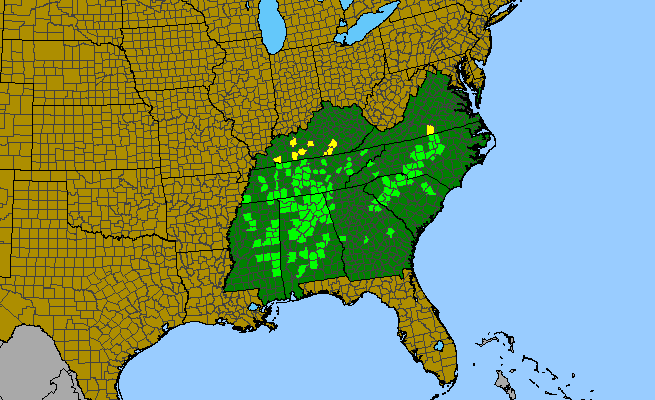
The native range of Carya carolinae-septentrionalis (Southern Shagbark Hickory)
Kartesz, J.T., The Biota of North America Program (BONAP). 2015. North American Plant Atlas. (http://bonap.net/napa). Chapel Hill, N.C. [maps generated from Kartesz, J.T. 2015. Floristic Synthesis of North America, Version 1.0. Biota of North America Program (BONAP). (in press)].
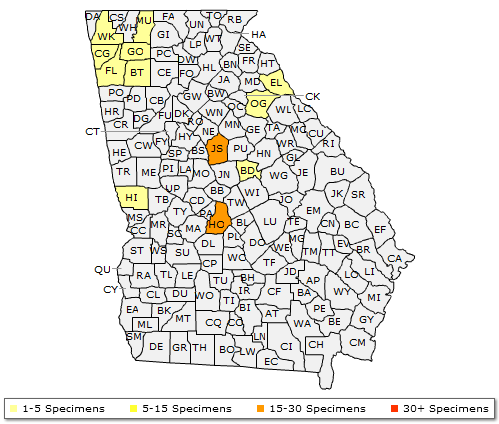
The Georgia range of Carya carolinae-septentrionalis (Southern Shagbark Hickory)
Zomlefer, W.B., J.R. Carter, & D.E. Giannasi. 2014 (and ongoing). The Atlas of Georgia Plants. University of Georgia Herbarium (Athens, Georgia) and Valdosta State University Herbarium (Valdosta, Georgia). Available at: http://www.georgiaherbaria.org/.
Guide to the Trees of North Georgia and Adjacent States
Web Page © Richard Ware
send Richard an E-mail